
Welcome to the Suvorova Lab
You can find our lab in the
Division of Infectious Diseases and International Medicine in the
Department of Internal Medicine at the
USF Morsani College of Medicine in
Tampa, Florida.
We study unicellular eukaryotes of the Apicomplexa phylum
Apicomplexa parasites are the causative agents of malaria, toxoplasmosis, and cryptosporidiosis in humans and animals. Each year, there are approximately 400,000 deaths from malaria, and 2 billon people are silently infected with T. gondii. These silent infections become deadly for the immunocompromised (AIDS and organ transplant patients), leading to severe acute toxoplasmosis.
Today, there is a race to solve apicomplexan biology as these parasites are resilient to drugs and vaccines. Apicomplexa are even developing resistance to “miracle” drugs like Artemisin that targets Malaria. To find weak links in apicomplexan physiology, we are unraveling the life cycle of parasites.
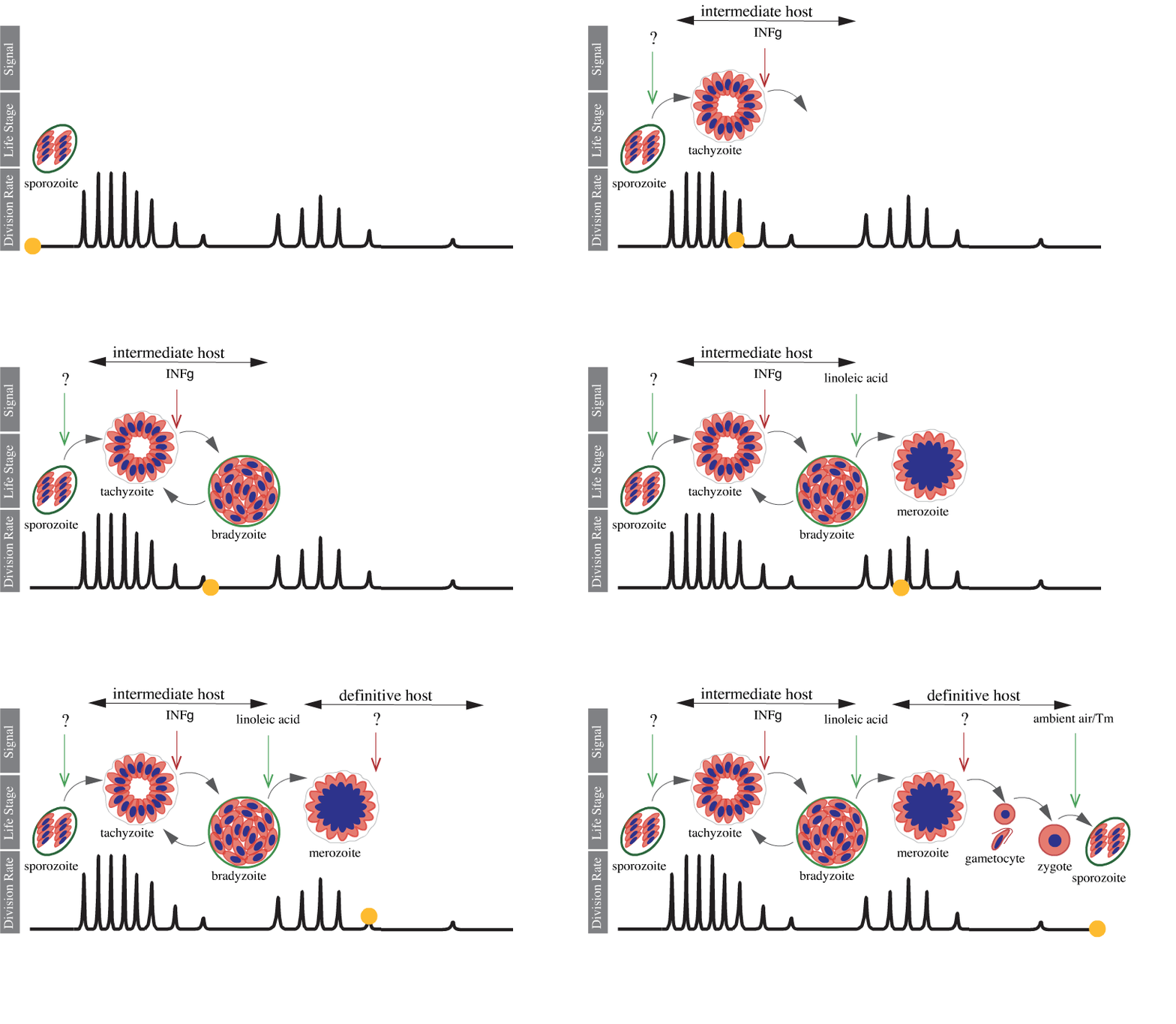
(Sinai and Suvorova, 2020)
Evolutionarily, apicomplexa are far removed from their respective animal hosts. This is reflected in the idiosyncratic mechanisms operating their life cycle and mitosis. Most eukaryotic animal cells and plant cells divide from a single DNA-containing nucleus to produce 2 offspring per cycle.
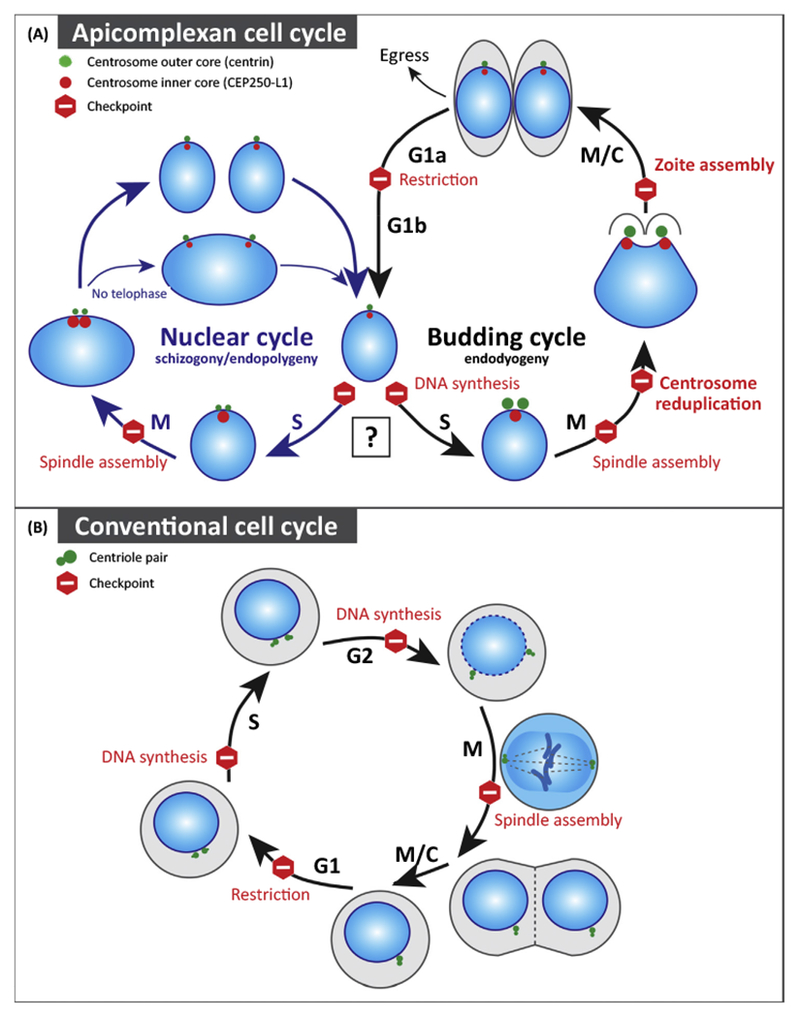
Apicomplexa are different – their mitotic cycles primarily rely upon multinuclear division, which allows them to produce 8 to 10,000 parasitic offspring per cycle.
Possessing a unique budding process, either form a multi-layered cytoskeleton inside of the mother cell, or at the mother’s surface to link and synchronize each round of mitosis.
Researchers have detected unique compartments in apicomplexa – and each structure is a potential drug target. Parasites form spindle in a nuclear membrane invagination, termed the centrocone (Dubremetz 1975). The bipartite centrosome coordinates cellular division (a novelty in apicomplexa). Invasion machinery is assembled as a complex of apical organelles (Suvorova et al., 2015). Our work focuses on the mechanism of Toxoplasma endodyogeny and replication that produces two nuclei with concerted internal budding.
Plentiful genetic tools permit editing of the haploid T. gondii genome, and various cellular markers facilitate exploration of intracellular organization. The asexual stages of T. gondii are relatively inexpensive to grow in vitro and in vivo. Experimentally, the Toxoplasma model provides benefits in speed and efficiency.
Sinai AP, Suvorova ES. (2020). The RESTRICTION checkpoint: a window of opportunity governing developmental transitions in Toxoplasma gondii. Curr Opin Microbiol. 58, 99-105.
Dubremetz, JF. ( 1975). Genesis of merozoites in the coccidia, Eimeria necatrix. Ultrastructural study. J. Protozool. 22, 71-84.
Suvorova ES, Francia M, Striepen B, White MW. (2015). A novel bipartite centrosome coordinates the apicomplexan cell cycle. PLoS Biol.
 The Suvorova Lab